Weekly pop culture magazine
Publisher:
Consolidated Press
Location: Sydney, ca. 1961 - 1968
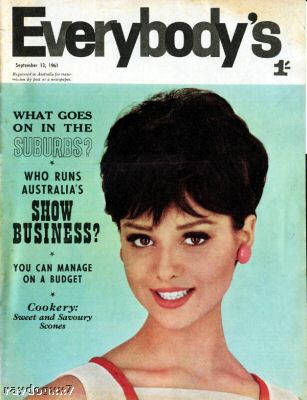
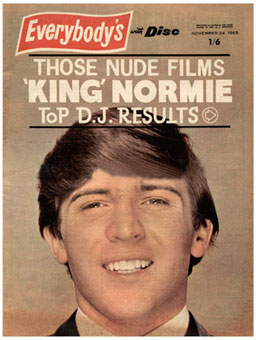
featuring the later red-and-white 'banner' logo.
| MILESAGO: Australasian Music & Popular Culture 1964-1975 | Press |
Everybody's magazine
|
Weekly pop culture magazine Location: Sydney, ca. 1961 - 1968 |
|
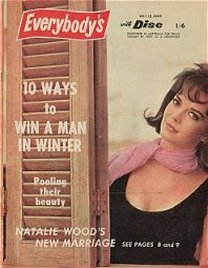
featuring the later red-and-white 'banner' logo. |
NOTES
 Everybody's magazine
was first
published in 1961. It was produced by Packer-owned Consolidated
Press company and evolved from from an
earlier
Packer tabloid magazine, Weekend, which flourished
in the 1950s.
Everybody's magazine
was first
published in 1961. It was produced by Packer-owned Consolidated
Press company and evolved from from an
earlier
Packer tabloid magazine, Weekend, which flourished
in the 1950s.
Weekend was edited by Donald Horne for many years and one of its most famous staffers was renowned journalist and rock writer Lillian Roxon, who wrote for the magazine for several years in the mid-1950s before moving to New York. According to Roxon's biographer Robert Milliken, Weekend had a rather dubious reputation in "polite society" -- it was considered very downmarket, since it regularly featured lurid stories, often with sexual overtones. Roxon's mother was reportedly horrified by the idea of her daughter working for such a publication and concealed the fact from friends and family.
When Weekend was relaunched as Everybody's, it replaced the venerable women's magazine The Australian Woman's Mirror, which was first published in 1924 and ceased publication in mid-1961. Copies of Everybody's from this period indicate that it was definitely a "women's" magazine in the early days, featuring almost exclusively women on the covers, with typical content including celebrity stories, cooking, interior decorating and fashion.
Left: The 22 September 1965 edition of Everybody's, featuring British model Patti Boyd. "OUR COVER: Winsome Pattie Boyd (girlfriend of Beatle George Harrison) is just the lady to model the latest mod fashions from the Chelsea boutiques. And the beauty of London's historical buildings provides a perfect setting for Pattie in the Modern Living feature "Anything Goes With A Swing" on pages 36 and 37."
Renowned Australian cartoonist and artist Marie "Mollie" Horseman (1911-1974) was Everybody's staff artist during the early 1960s. Her numerous
illustrations (either anonymous or signed "Vanessa") included a weekly
full-page colour cartoon of the Sexy
Man type and the serial "Girl Crusoe" (1964),
a parody of the popular 'good girl cheesecake'
comic. In 1963 Everybody's hailed her
(somewhat inaccurately) as 'Australia's only woman cartoonist',
although she was definitely the best known.
As the 'Beat Boom' took off in 1963-1964, Everybody'sbegan
to cater for the burgeoning teenage market. Its content
increasingly featured stories and pinups of local and
international pop music, movie and TV
personalities, although it still made regular excursions into tabloid
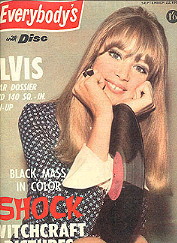
territory, as evidenced by the covers shown, which feature teasers
like "Black Mass in Color: Shock Witchcraft Pictures", "The World's
Most Topless City",
"Trade Secrets of a Female Impersonator", "The World's Most Famous
Nudes", "Those nude films", "What goes on in the suburbs?" and "Jayne
Mansfield Tells All: Those Lewd Film Star Orgies".
Pop culture historian Jeffery Turnbull
describes Everybody's as:
"... really the ultimate magazine for Australia’s popular
culture throughout the pre-Go-Set,
early ‘sixties because it
covered the biggest stars of the period and wasn’t afraid to
feature young Australian rock stars. It was published by the Packer
organisation in Sydney but its circulation was national and in fact
international, as it reached New Zealand readers. It did, however lean
towards the Sydney scene. Kiwi musicians Mike Rudd (Spectrum and Ariel)
and Glyn Mason (Ariel, Chain, Copperwine, Stockley See & Mason)
have both spoken of the influence which Everybody’s
had on New Zealanders in informing them of the swingin’ scene
in Australia. Just to read about what was happening in Australia was
enough to convince them to relocate across the Tasman Sea with their
respective New Zealand Bands, Chants R & B and
Larry’s Rebels."
"Everybody’s
was not effectively targeting the teen market as such, but aimed itself
more towards the young adult profile and was a quality pictorial
although at times it delved into the sort of stories that the lower
quality tabloids liked to feature. From about 1964, it incorporated Disc
magazine -– an insert specially dedicated to pop music and
this was only really superseded when Go-Set came
along. It covered everything from Australian lifestyle to views on
current issues as well as fashion. Its format was colourful and bold
and at times, it wasn’t afraid to feature the more
insalubrious aspects of the new teen culture."
"Possibly for the
first time, Aussie rock and pop artists were featured – often
on the cover. In 1967, The Masters Apprentices were
presented with a trophy from Everybody’s
as the “Most Original Band” for that year. Everybody’s
was, like Pix, People and Australasian
Post open to featuring the more liberalised attitudes towards
sex. Towards the latter part of the ‘sixties, this magazine
found a strong challenger in Go-Set which began to
focus even closer on the teen readership market. By 1968, all eyes were
on the Melbourne scene and Everybody’s
succumbed to the punches delivered by its new
challenger, ceasing publication in that year." (2)
Everybody's enjoyed a comfortable relationship with Festival Records, which was owned by the Packers' rival, News Ltd, and it did much to promote Festival artists such as Jimmy Little, whom it named "Australian Pop Star of the Year" in 1964. The magazine also covered a range of social trends; in 1964 it examined the "new beach cult" and fretted about the "surfies" -- "they come from good homes, they are well educated, why then, do they turn into common larrikins?" Everybody's also included cartoons, most notably The Phantom by Lee Falk:
"When The Phantom finished in the last issue of The Australian Woman's Mirror in June 1961, it was almost immediately picked up in Everybody's. The last story to appear in the Woman's Mirror was The River Gang (S54) but only the first 8 weeks of the 20 week story were published. It is not known if this story was completed in Everybody's Magazine. However, the next story The Honeymooners (S55) certainly was, and the weekly magazine continued with the Phantom Sunday strips in sequential order. The one exception was The Astronaut and the Pirates (S61) which was initially skipped before making an appearance a few years later. As with the Woman's Mirror, the Phantom strips in Everybody's Magazine were about 16 months behind the original US newspaper appearance date. The last known Phantom story to appear in Everybody's Magazine was Rex King (S68) in 1967. The magazine was cancelled in 1968 although it is not known if The Phantom continued until the end." (3)
 The magazine also played a role in launching the career of TV and pop personality Denise Drysdale:
"Barry Bell at Channel 9 had taken some photos of me in a bikini for 'Everybody's Magazine', and that magazine had gone over to Vietnam, and American soldiers saw me, got in touch with Everybody's Magazine, and so they gave me 'Girl of the Year' ". (6)
Everybody's dominance was challenged in early 1966 with the appearance of a new Melbourne-based weekly pop magazine, Go-Set, which was launched by a group of former Monash University students. Although Everybody'senjoyed the advantage of produced by a major publishing house and had an established national readership, its position was quickly usurped, and from 1967 until its closure in 1974, Go-Set reigned supreme as Australia's pop culture 'bible'.
In 1967 Everybody's attempted to expand its operations by starting up its own Everybody's record label, set up with the intention of selling singles via the magazine. The new label was a joint venture between Clyde Packer and Harry M. Miller and managed by American-born entrepreneur, producer and songwriter Nat Kipner. This move the label was resisted by radio stations, however, and some Sydney stations reportedly refused to play the label's inaugural single -- Tony Barber's "Someday" -- because it was seen (not unreasonably) as blatant cross-promotion for the magazine. As a result the label was hastily relaunched as Spin Records and it became one of the most significant local pop labels of the late 1960s.
By the late '60s the focus of the Australian pop scene was firmly in Melbourne and while Go-Set (which was also based in Melbourne) evolved with the times and developed close links with the local pop scene, Everybody's essentially retained the one-dimensional "fanzine" style it had developed in the early 60s. Its circulation gradually declined, out-competed by the 'hipper' style of Go-Set, and it ceased publication during 1968.
References / Links
1. Dave Guard article, Everybody's, June 30, 1965
http://users2.ev1.net/~smyth/linernotes/articles/Everybodys/June30-65/Everybodys.htm
2. Hank B. Facer
Museum of
Indigenous Recording Labels
http://mirl.hypermart.net/mirl_page_2.htm
3. Peter Wilmoth
"Blue Heaven: The History of Australian Surfing" (book review)
The Sydney Morning Herald, 27 December 2003
http://www.theage.com.au/articles/2003/12/24/1072239717015.html?from=storyrhs
4. Bryan Shedden
"The Phantom: A Publishing History in Australia"
http://www.deepwoods.org/everybodys.html
5. Australian Dictionary of Biography
Marie "Mollie" Compston Horseman
http://www.adb.online.anu.edu.au/biogs/AS10232b.htm
6. Talking Heads, ABC-TV, 1 May 2006
Denise Drysdale interview
http://www.abc.net.au/talkingheads/txt/s1624762.htm